Manchester United–Liverpool rivalry
Player Manager: A Sports Progression FantasyThe Manchester United–Liverpool rivalry is one of the defining relationships in English football, combining an exceptional record of success with a hostility that extends from league history to the streets around the stadium. In the novel, it is encountered through Manchester United’s humiliation, Liverpool’s status as an old rival and global power, and the uneasy movement from online supporter culture to the physical atmosphere of a match at Old Trafford.
Historical Scale and Competitive Meaning
Manchester United have won England’s top league twenty times, while Liverpool have won it nineteen times. The near-parity of those records helps explain why the rivalry is more than a contest between two prominent clubs: it is a struggle between two of the biggest and most famous teams in the world, with generations of supporters invested in which institution occupies the higher ground. The rivalry’s intensity is described as “white hot,” making historical achievement part of the emotional ammunition exchanged by the fans.
For Manchester United supporters, Liverpool represent an especially unwelcome opponent because the fixture joins present disappointment to memories of former supremacy. United’s miserable start leaves the club at the bottom of the league, and the prospect of facing Liverpool becomes an occasion for humiliation rather than a straightforward opportunity to recover. The match therefore carries two stakes at once: United may lose another game, but a defeat to this particular opponent would confirm the club’s fall in a rivalry traditionally associated with prestige and power.
The Supporter’s Approach to Old Trafford
After the disastrous weekend, Max Best receives a flood of offers from disgusted and furious Manchester United supporters who want to sell tickets for the next game. He pays sixty pounds for one, collects it in person, and endures the seller’s ten-minute denunciation of the players. The ticket is expensive, but it gives Max access to the Liverpool fixture and, more importantly, a chance to investigate the curse affecting his experience of football. He expects to be one of the few United supporters in the stadium who can claim that the match has a personal investigative purpose.
Max does not approach the game with uncomplicated enthusiasm. He expects Manchester United to be “pissed on” by Liverpool, which he regards as one of the three best teams in the world, yet he is also convinced that the match may provide definitive answers about the curse. This mixture of fatalism and curiosity turns the rivalry into a testing ground: the result matters as football, but the encounter also becomes evidence in Max’s attempt to understand what has happened to him.
Hostility Around the Stadium
The approach to Old Trafford transforms the rivalry from an abstract history into a physical crowd experience. Max has not attended a match, concert, or film for years, dating back to before the pandemic, and the prospect of entering a space containing seventy-six thousand people triggers his anxiety about illness and contamination. The stadium is consequently both a football ground and an overwhelming concentration of bodies, noise, memory, and collective feeling.
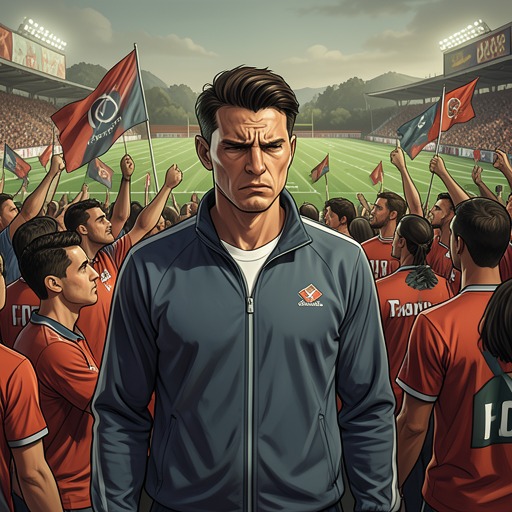
In Firswood, Manchester United supporters gather around a car to check the team news, while another group stands outside The Quadrant pub drinking and laughing. On Warwick Road, the movement toward the stadium grows from a trickle into a stream and then a river. Outside one corner of the ground, Liverpool supporters sing, chant, and take selfies and TikToks. They are described as enemies, with only a hint of menace separating calm from possible disorder. The danger is not necessarily visible in a single act; it exists as an undercurrent, a submerged hostility produced by the rivalry itself.
Inside Old Trafford, the away end is noisy and openly mocking, while Liverpool supporters gloat at the home crowd. The songs have changed with the players and the times, but the function of the chants remains familiar: they mark territory, ridicule the opponent, and convert the stadium into a confrontation between identities. When the match begins, an enormous roar makes the hairs on Max’s neck stand up, registering the rivalry as a bodily force before the narrative has to explain it intellectually.
Rivalry, Club Identity, and the Football Pyramid
The relationship between Manchester United and Liverpool also illuminates the novel’s contrast between elite football and community-rooted clubs. Manchester United’s immense spending and global stature appear alongside Max’s criticism of a cycle in which managers are hired, hundreds of millions of pounds are spent on preferred players, and the manager is then dismissed, leaving expensive players on the bench or in reserve. Liverpool’s prominence makes the fixture commercially and symbolically enormous, but that scale is set against the smaller institutions through which Max later seeks to build a football career.
His search for opportunities takes him down the football pyramid to FC United of Manchester. The club was formed by former Manchester United supporters who quit in disgust after the sale of United to “some vulture capitalists,” creating their own club so that they could feel like fans rather than customers. Its identity is therefore partly defined through opposition to the commercial direction associated with Manchester United, even though it remains connected to the city and to United’s history. The club competes in the Northern Premier League Premier, England’s seventh-highest league, with promotion leading through the National League North and National League toward League Two.
FC United’s small stadium offers a counter-image to Old Trafford’s scale. Max enters a tiny but complete ground with concrete stairs, signs for the Lightbowne Road End and S4-S2, separate men’s and women’s toilets, a place selling beer and pies, red, white, and black backdrops, witty banners, and hyper-local sponsorships. Volunteers sweep crisp packets, repair seats, and remove chewing gum; an older man with the profile of an eighteenth-century prime minister scrubs the dugouts. The contrast does not make the smaller club unreal. On the contrary, Max finds that it “stank of football,” and the volunteer labor gives the place a form of authenticity absent from the impersonal scale and extravagant expenditure he associates with elite football.
Community Ownership and the Limits of Sporting Authority
The rivalry’s institutional background becomes clearer through Chester FC, another community-oriented club shaped by the failure of a previous organization. Mike Dean explains that Chester City was run into the ground by its owners, folded, and expelled from the league before Chester FC was formed as a community-owned and community-run club. For Mike, the club is financially tiny compared with the large businesses he once managed, yet it occupies an outsized place in the local community. Its survival depends on sponsorships, balance sheets, and cautious decisions rather than on the resources available to Manchester United or Liverpool.
That survival logic limits what Max can demand from a club. After Max disrupts the youth team, Mike warns that one parent is a sponsor whose contribution is worth eight thousand pounds a year. The figure may seem modest beside elite football’s budgets, but it is substantial to Chester, and the incident threatens not only money but the relationship between the club and its community. Mike insists that the boy Max has rejected is a Chester lad, a Chester fan, and a supporter proud to wear the club’s colours. In this setting, treating a player as disposable can amount to attacking the very community the club exists to serve.
The same institutional limits shape the possibility of Max’s employment. Chester cannot spend fifty thousand pounds a year on a Director of Football, and a public appointment would not go to a twenty-two-year-old with almost no experience in the game. City Fans United owns the club, and its supporters’ trust participates in the governance that constrains Mike’s authority. Mike is formally the manager’s boss when he hires and fires him, but in the intervening period the manager remains “the captain of the ship.” Max’s football knowledge may be valuable, yet it cannot simply override community ownership, established authority, financial risk, or the obligations created by local belonging.
From Fan Rivalry to Professional Opportunity
The Manchester United–Liverpool rivalry indirectly helps drive Max toward a different understanding of football work. He begins as a United supporter seeking a ticket to a hostile fixture and trying to use the match to decode his curse. He then moves through non-league and community football, where access depends less on money than on relationships and practical usefulness. Jackie Reaper has to explain that agents and scouts do not pay full price to attend matches: they call the club and ask for tickets to watch a particular player. Max’s failure to know this exposes his outsider status even as he attempts to enter the profession.
His involvement gradually becomes more formal. Jackie acts as his agent in negotiating a scouting arrangement with Mike, securing one hundred pounds per match, expenses for petrol and parking, ten pounds for a pie and programme, and tickets arranged by the office. Max accepts the deal partly because it offers experience and partly because it grants him free experience points and money. He immediately asks whether there are teams he can manage for one-off games, and Mike offers him the Knights. The request marks a shift from consuming rivalry as a fan to treating football as a field of work, observation, responsibility, and consequence.
That transition remains conflicted. Max wants the authority to impose what he sees as superior football ideas, while community clubs require diplomacy and patience. Mike eventually tells him that Chester needs a Director of Football-type figure but cannot appoint him meaningfully without evidence of experience. The compromise is to begin small and grow the role over time, with Max’s goal analyses and practical contributions serving as a trial. In this way, the rivalry between Manchester United and Liverpool forms the spectacular outer frame of Max’s football imagination, while the quieter world of FC United and Chester teaches him that football’s institutions are sustained by volunteers, sponsors, supporters, and negotiated trust.
Narrative Significance
The rivalry functions as a measure of scale. At Old Trafford, seventy-six thousand people produce a roar, songs, mockery, and an invisible threat; at FC United and Chester, a handful of workers repair seats, scrub dugouts, sell food, protect sponsorship income, and argue over who has the right to shape a team. Neither setting is presented as irrelevant to football. The elite fixture concentrates history and hostility, while the community clubs reveal the labor and vulnerability beneath the sport’s public image.
It also supplies a recurring contrast between football as spectacle and football as social infrastructure. Manchester United and Liverpool embody accumulated titles, global fame, and white-hot antagonism. FC United embodies a rejection of supporters being treated as customers. Chester embodies the painful responsibility of keeping a phoenix club alive after institutional collapse. Max’s movement among these worlds transforms the rivalry from a simple opposition into a question about what a club is: a brand competing for trophies, a business handling enormous sums, or a community asset whose survival depends on people who continue to show up and do the unglamorous work.